
Cosmic Compensation
a guest essay on self-betrayal by Jodi Arndt

The following was written by the brave and brilliant Jodi Arndt who you should follow immediately on substack. I love you, Jodi. Thank you for sharing this one with us here. <3
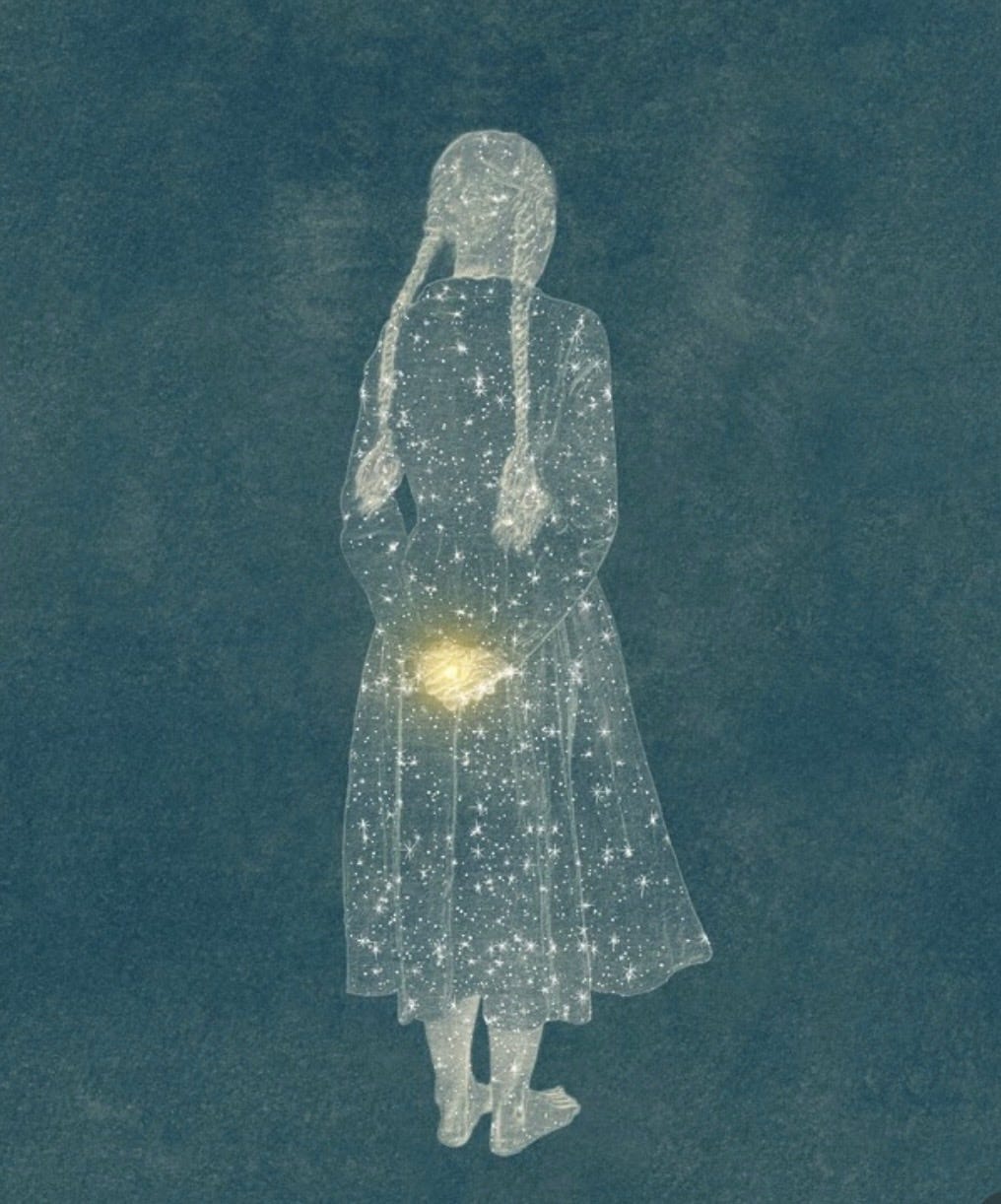
I sat with the old check in my hand, confronted with evidence of the betrayal. The signature, a sprawling imitation of my name, penned in his hand, stared back at me. Suddenly sick, I ran and spewed the contents of my stomach into the toilet. Months later, snow slapped the lakefront of a therapist’s tiny Hyde Park office.
“I don’t understand why you won’t forgive yourself. It’s almost as if you have forgiven him, but not yourself. You stayed because you loved his daughter. You stayed because you didn’t want to believe the evil of a person. This act of staying doesn’t mean you suck as a person, it means you’re human. You gotta forgive yourself, Jodi”.
Ten winters later, my therapist was right. I still saw myself as an accomplice in the heist. It had been ten winters of nursing fury, sitting with shame, of trying to forget, only to remember. I’d resisted the idea of therapy for years because therapy meant I’d have to tell what I’d accepted, that I’d have to retrieve the list of lies from the neglected corners of my mind and repeat them out loud.
How could I admit what I once believed: I am what I can do for other people.
The words would float and the room would bear witness to what I’d rather stuff inside, and God, I felt sorry—for even the furniture that would endure that sad revelation.
A year after he forged that check, we returned to Chicago from North Carolina. Following my family’s annual trip to Galena: Mom, Dad, kids, grandkids-all in one house together. Dwane and I were now back in the city in our walk-up apartment in Lincoln Park. He sat in the bedroom with the door closed, working on his laptop. I lay on the other side of the door, clutching my stomach. Outside, through gaps in the blinds, the mailman shuffled up the walk, his boots caked with snow, hands mittened and palming the neighbor’s mail.
“Can you please walk over to Walgreens and get me a box of popsicles?” I begged.
Silence.
“Dwane, can you please, please, get me popsicles? I can’t keep anything down; my mouth is killing me.”
Nothing.
“What the—. Can you at least answer me?”
“Ok! Yes, I will go get them. Hold on!” he puffed
I waited and scanned the room for my purse to anticipate what would come next:
Jodi, where’s your wallet?
The first time he asked me for money, we were in Charlotte, and I responded with an unequivocal NO. “That is my money,” I said. “Not yours, not ours. It is mine and you can’t have it.”
But the mortgage payment on his Mom’s house was a bit behind—the house that stared back at me on the driveway where we sat in the car. You will get it back, he said, I promise.
We probably weren’t even there for a full week before he asked. Canyons of my possessions were on their way to this strange house that stood there mocking me now. How could I explain the leaving? And how could I rationalize the coming? I might call the truck and tell them to turn the hell around, that I’d had a change of heart and made a mistake.
Yes, that’s right, I’d tell them; I’ll pay whatever. It was all a ruse.
The neighbor’s garage door opened with a yawn across the street, and in the rearview mirror, I spotted a suited man, travel mug in hand, fumbling with his keys before they rattled onto the garage floor and slid under the car.
I pressed my right hand into the dashboard to steady myself, now motionless in the driveway in this foreign place, the contents of my life waiting to be schlepped by a moving truck that has yet to arrive at the house with the unpaid mortgage.
I stayed, and still he wrote that check ($1,600) from my home equity loan. Like any man who doesn’t have his own money but sure would like yours, he pressured me to get the full amount the bank was offering. That entire year in Charlotte, I financially supported us and would go on to do so when we moved to Chicago, too. I remember being so broke at the Aldi’s on Wilson that the woman behind me paid for my groceries one morning. I cried in the car. But that wasn’t the last time I cried. The unexplained phone calls on the back patio, where he’d feverishly wave me away as if I were a pest to be squashed or the weekends I’d spend with his daughter at Mom and Dad’s alone– he off somewhere unreachable or the-I-don’t-know-where-your-Dad-is-he-won’t call-me-back after I called to tell him my Mom taught his daughter how to ride a bike… The relentless cycle of him saying one thing but doing another.
Still, I stayed with a man who put a $6,000 Breitling watch on my credit card, promised to take it back when I freaked out, but didn’t. I stayed and the Universe shrugged.
Years later, he’d erroneously tell a friend that we drifted apart, and no, this lie didn’t surprise me because his love of fiction was well known by this point. Like any grifter, he’d scout for the next round of female opportunities and move to Aspen or Vail or one of those ski towns with plenty of wealthy women. Someone would send me a link to an article from a local paper proclaiming what a good guy he was, how much he persevered through some health challenges as he stood in some martial arts uniform, inflated with applause and smiling.
***
That first Thanksgiving, when he met my parents, Dad observed, Not all families are like ours. Do you really know him? All my friends were getting married, and I wasn’t. So, I figured God had some answers. With all of the episodes of Sex and the City catalogued for memory back then, I related to Charlotte’s honest whine-filled plea: I’ve been dating since I was 15. I’m exhausted!! Where is he already?! and made a plea of my own to God, just like hers. God must’ve had ear muffs on or a wicked sense of humor because the man that showed up was the antithesis of what I was asking for. Then one spring, I returned to our Lincoln Park apartment for lunch on a work day to a ringing cell phone buried under couch cushions. His phone had row after row of women’s names in the call log.
I left.
Mom, navigating Alzheimer’s, attempted to comprehend what prompted me to leave him at last, while Dad tried to coach me into telling the truth, “Jodi, the best thing about you is that you are so generous, so trusting. That is why I worry. I don’t know. Maybe it’s my fault,” Dad’s words trailed off as he massaged his face.
We were sitting toe-to-toe in the family room, the click-ity-clink of the heater punctuating the fits of silence between us.
“Listen, I know you’re not telling us everything. You give and give, people see that. What does he do for you? We didn’t raise you to get taken advantage of like this, Mom and I. Maybe I had something to do with it, maybe me not being home enough— I worked so much when you were a kid, maybe that had something to do with it,” he said, defeated.
I attempted to explain that I prayed for his and Mom’s version, and that yes, they had taught us all how to love and be loved, but maybe the model was not attainable. Or maybe I was incapable of such a task. My shoulders rose like hiccups from the basement of my belly to meet my ears as I shook into heaping cries. I am so fucking ashamed of myself. How did I allow this to happen? How did my worth become a calculated transaction? I hate myself.
It has taken decades for me to tend to the neglected corners of my mind, the place where shame and self-betrayal have huddled to regain my agency. It has meant sifting through the after effects of the financial abuse to admit a decades-old loop of self-sabotage where men crossed my loose boundaries and borders with ease, because at least they asked before they took.
Today, I’ve come to understand that we all pray for the wrong thing sometimes. That the ask—for the man to arrive — wasn’t the answer. So I retrieve the list of all that he took from me. It’s the trust I once had in myself and lost—-it’s that trust that cannot be repaid or returned.
Sifting through the abuse sent me directionless for decades, and soliciting for love to earn my keep with that worn belief: I am what I can do for other people.
Today, I do the work to get reacquainted with myself and recognize that I can be a trusted compass.

I see myself more clearly now, and I quite like her, this woman worthy of a man who’d joyfully–and without question—— cross the street for a box of popsicles.
Jodi is an educator and essayist whose writing fearlessly explores the intersections of family legacy, trauma, and personal agency. After losing both her parents to the long, devastating ripple effects of Alzheimer’s, she turned her lens inward to sift through parallel losses: the loss of a mother to dementia, a father to caregiving, and the temporary loss of herself to a grifter. A survivor of financial exploitation, Jodi’s essays examine what happens when we tie our worth to what we can do for other people. She is currently working on her book, The Patron Saint of Memory, a testament to reclaiming one's agency, rebuilding boundaries, and surviving through the ministry of small moments. You can her on substack, here, Instagram here and on her website.
 | A guest post by
|